
Placing Stolspeed Vortex Generators on a Savannah
Stolspeed VGs are well proven for the Savannah as I fly onw myself and we have another three at our airfield. If your Savannah already had factory-installed VGs, place the Stolspeed VGs directly over the same holes provided for placement. The old mounting holes will show through the new transparent VGs, so it’s a good idea to paint them before installing.
If your Savannah did not have VGs previously, position the front tips of the VGs 175 mm in front of the main rivet line on the top of the spar.
Spacing is 60 mm for the first 15 VGs in from the wingtip, and 90 mm spacing for the remainder.
Elevator VGs on Savannah XL and S Models
The Savannah XL and Savannah S models can benefit from VGs on the elevator. Place the VGs on the underside of the elevator, as far forward as the curvature of the surface allows, spaced at 30 mm. At cruise speed, these VGs remain hidden, but they protrude into the airflow when the elevator rotates upward at the landing attitude enhancing elevator authority and stability.
Removing Slats on the Classic Model
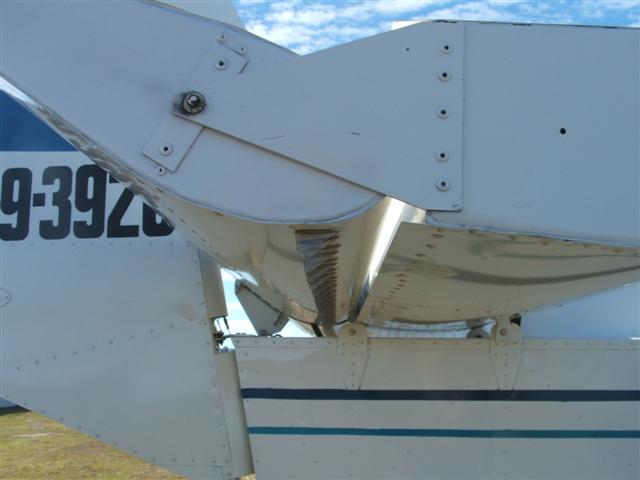
The easiest and cleanest way to remove the slat brackets is to cut them off about 12 mm from the skin, following the leading-edge profile.
This leaves them looking like miniature stall fences, so you don’t need to fill the holes in the skin. Here’s an example of a particularly neat and simple solution.
Real Flight Tests Comparing Slats with VGs on the Savannah
Comparing Three Wing Setups
-
Original Slats
-
Original Wing with Vortex Generators (VGs)
-
Savannah “VG” Leading Edge
Why I Started Testing
Back in 2006, I was the first to remove the slats from the original Savannah wing and install vortex generators to regain almost the same short takeoff and landing (STOL) performance, while gaining faster cruise speed and better fuel efficiency. The results were surprising but real. The main reason for slats is to get great STOL performance. So when I replaced them with VGs, it created a lot of skepticism. But after testing and sharing results, the ICP Savannah factory eventually dropped the slats and released a “VG” model. Many Zenith 701 owners did the same and were happy with the outcome.
I’ve always preferred real testing over marketing claims. I started as a skeptic of VGs but became convinced after seeing how much they help high-lift wings. That’s what led me to start producing and selling them.
I fly about 150–200 hours a year, mostly on long trips across the Australian outback. Fuel efficiency and short-field performance are both critical for that kind of flying. On one 60-hour trip in 2009, I saved around A$350 in fuel compared to using slats. After more than 900 hours since removing them, the savings really add up. I often land off-strip and camp, so I’ve optimized my aircraft for adventure flying. Many pilots around the world have the same goals, and it’s been great to help them get better performance.
What We Tested
I had the chance to fly a Savannah in three different setups:
-
With Original Slats
-
With Slats Removed and VGs Added
-
With Factory “VG” Conversion
The results from these tests were surprising and go against some common assumptions. Thanks to Ken for providing the aircraft and for putting it through a lot of test flying.
The tests are divided into two parts:
-
Original Slats vs. Original Wing with VGs
-
Original Wing with VGs vs. Factory “VG” Wing
How the Tests Were Done
All tests were done under consistent conditions: You can read more about flight testing here
-
Altitude: 2000 QNH
-
Temperature: 14°C
-
Weight: 430 kg
Stall Tests
Each stall test was performed by slowly reducing airspeed in level flight until the aircraft could no longer maintain altitude. Variations were within ±1 knot.
Climb and Glide Tests
Timed climbs and descents between 2000 and 3000 feet using a stopwatch early in the morning when the air was smooth. Several runs were averaged for accuracy.
Airspeed Checks
A Hall airspeed gauge on a swiveling vane was used to verify pitot readings. The standard pitot showed big errors at high angles of attack, so I fitted a 10° downward-canted pitot, which worked much better down to 30 knots.
GPS Verification
Four-way GPS runs confirmed low-speed readings. Below 35 knots, readings became unreliable, but the results were consistent for comparisons.
Slats vs. Vortex Generators on the Original Wing
These results also apply to the Zenith 701, which uses the same wing and slats.
Stall Speeds
| Configuration | Clean | ½ Flap | Full Flap |
|---|---|---|---|
| Slats | 32 kt | 30 kt | — |
| Original w/ VGs | 34 kt | 30 kt | 28 kt |
At 2000 QNH, 14°C, and 430 kg:
Only 2 knots difference clean, and the same stall speeds at half flap.
Climb and Glide
-
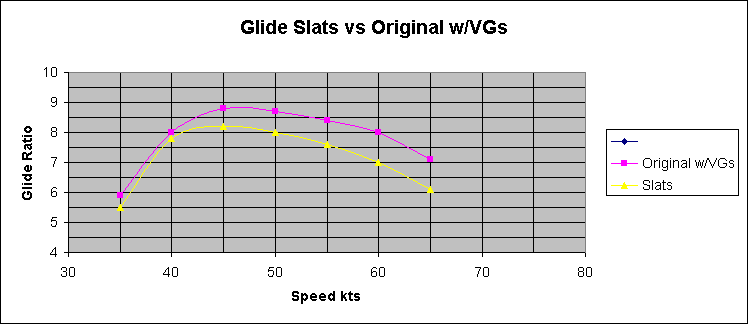
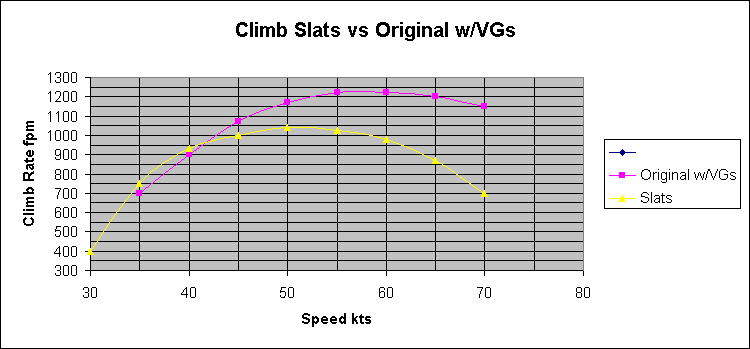
Best Rate of Climb: 50 kt (Slats) vs. 55–60 kt (VGs)
-
Rate of Climb: 200 fpm higher with VGs
-
Glide Ratio: 8.2:1 (Slats) vs. 9.1:1 (VGs)
-
Minimum Glide Speed: 35 kt (both)
Cruise Performance
-
About 6 knots faster without slats
-
Accelerates faster and climbs steeper
-
Requires less nose-down attitude when gliding
Landing
-
With Slats: Loses speed quickly in the flare and needs careful power control
-
Without Slats: Flies more like a regular airplane, floats farther, and lands softer
-
Touchdown Speed: Almost the same
Climb Angle
| Configuration | Speed | Rate of Climb | Climb Angle |
|---|---|---|---|
| Slats | 40 kt | 930 fpm | 13.4° |
| VGs | 47 kt | 1070 fpm | 13.8° |
Even though slats look like they’d climb steeper, they don’t. Their drag actually reduces climb performance. The VG wing still has plenty of lift but with less drag, giving better climb and recovery margin if the engine fails.
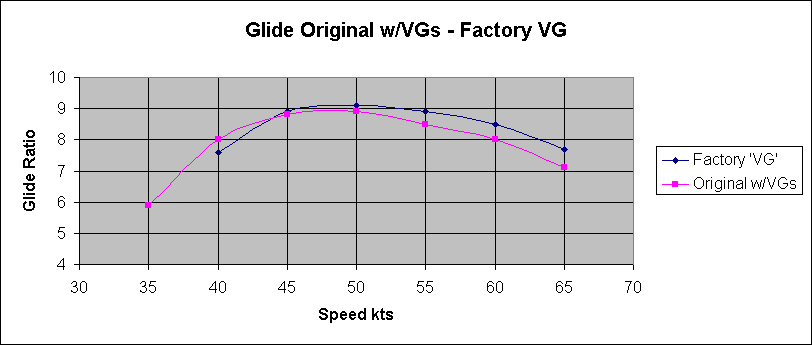
Comparing the Original VG Wing and the Factory “VG” Wing
This comparison focuses on the Savannah models. After my VG tests, ICP removed the slats and introduced a factory “VG” wing with a smoother, more rounded leading edge. It added a bit of wing area (0.51 m²) but reduced aspect ratio slightly. Some pilots said it felt different, so I tested it properly.
Stall Speeds
| Configuration | Clean | ½ Flap | Full Flap |
|---|---|---|---|
| Original w/ VGs | 34 | 30 | 28 |
| Factory “VG” | 36 | 33 | 31 |
Cruise Speeds
| RPM | Original w/ VGs | Factory “VG” | Difference |
|---|---|---|---|
| 4600 | 71 kt | 72 kt | +1 |
| 5000 | 76.5 kt | 78 kt | +1.5 |
| 5200 | 80 kt | 81.5 kt | +1.5 |
| 5400 | 84 kt | 85.5 kt | +1.5 |
-
Slightly faster cruise (1–1.5 kt) with the Factory “VG”
-
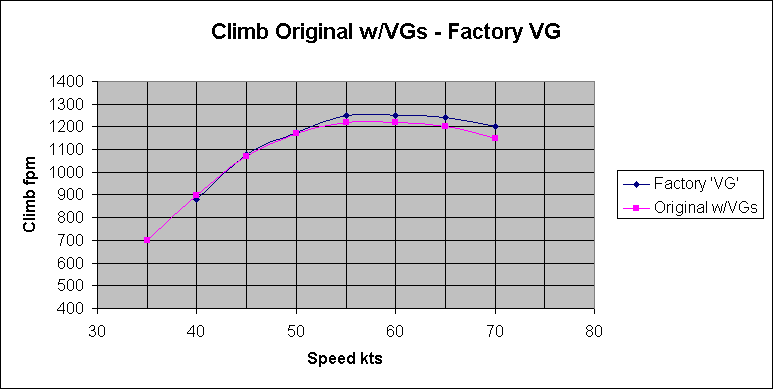
Small climb advantage at higher speeds
-
Stall speeds 2–3 kt slower with the Original VG setup
-
Glide performance about the same
Flight and Landing Feel
No noticeable difference in flight or landing handling. The Original VG wing had a slightly softer stall, but both worked well.
-
The smoother leading edge on the Factory “VG” wing gives a little less drag.
-
The Original VG setup performs slightly better at very low speeds.
-
Both are good, and neither shows the big performance claims sometimes advertised.
What We Learned
-
The Original VG wing has no weaknesses or stability problems.
-
Torque roll and full-flap takeoffs are the main things to watch for.
-
Never take off with full flaps; they add drag and reduce control.
-
Using proper rudder during slow climbs stops any wing drop from torque roll.
-
The VG wing is safe and predictable even at maximum weight (560 kg).
The Bottom Line
After more than 900 hours and a lot of testing:
-
The Original Wing with Stolspeed VGs performs about the same as the Factory VG Wing
-
It climbs as well or better than the slatted wing
-
It cruises faster and more efficiently
-
It stalls smoothly with no nasty surprises
-
It’s safe and easy to handle when flown correctly
In short: The Original Wing with VGs gives excellent performance, great efficiency, and keeps the STOL ability without the drag and complexity of slats.