
Gday all I'm John Gilpin (JG),
3500 hrs flying experience, mostly STOL related, and much of it remote area touring. Always building, modifying, testing, and flying Recreational (RA) Aircraft. Enthusiastic experimenter, always seeking new discoveries.
I've toured over pretty much all of Australia in my Savannah and before that in a little Spectrum Beaver ultralight, with a tent under the wing. I have also had many flying adventures touring the Western USA particularly the high deserts. At 73, I set off in mid March 2012 on a flying roadtrip around the USA that covered 48 airfields in 14 states. 24,000 miles (40,000 km).
You can find a record of my travels in my blog.
Australian Outback Flying Adventures Part 1
Australian Outback Flying Adventures - Part 2
Australian Outback Flying Adventures - Part 3
Australian Outback Flying Adventures - Part 4
Building the high clearance trail bike
USA Flying Adventures
You well may ask how I could afford to do so much flying. I'm certainly not rich. But I've worked hard and saved and made a couple of good investments, and most importantly live very frugally. Drive old cars to their death, live in a bachelor flat in my workshop, never eat out and seldom go to the pub. When on flying trips I camp under the wing and never pay for a bed. Most folk would consider this life-style to be deprived, but I'm fortunate in that the adventure of it all suits me just fine, wouldn't desire for more. Always do my own maintenance and aircraft building and repairs, made possible by the RAAus homebuilt category rules. Capital cost and running cost about the same as a good 4WD.
So all that flying was easily affordable.
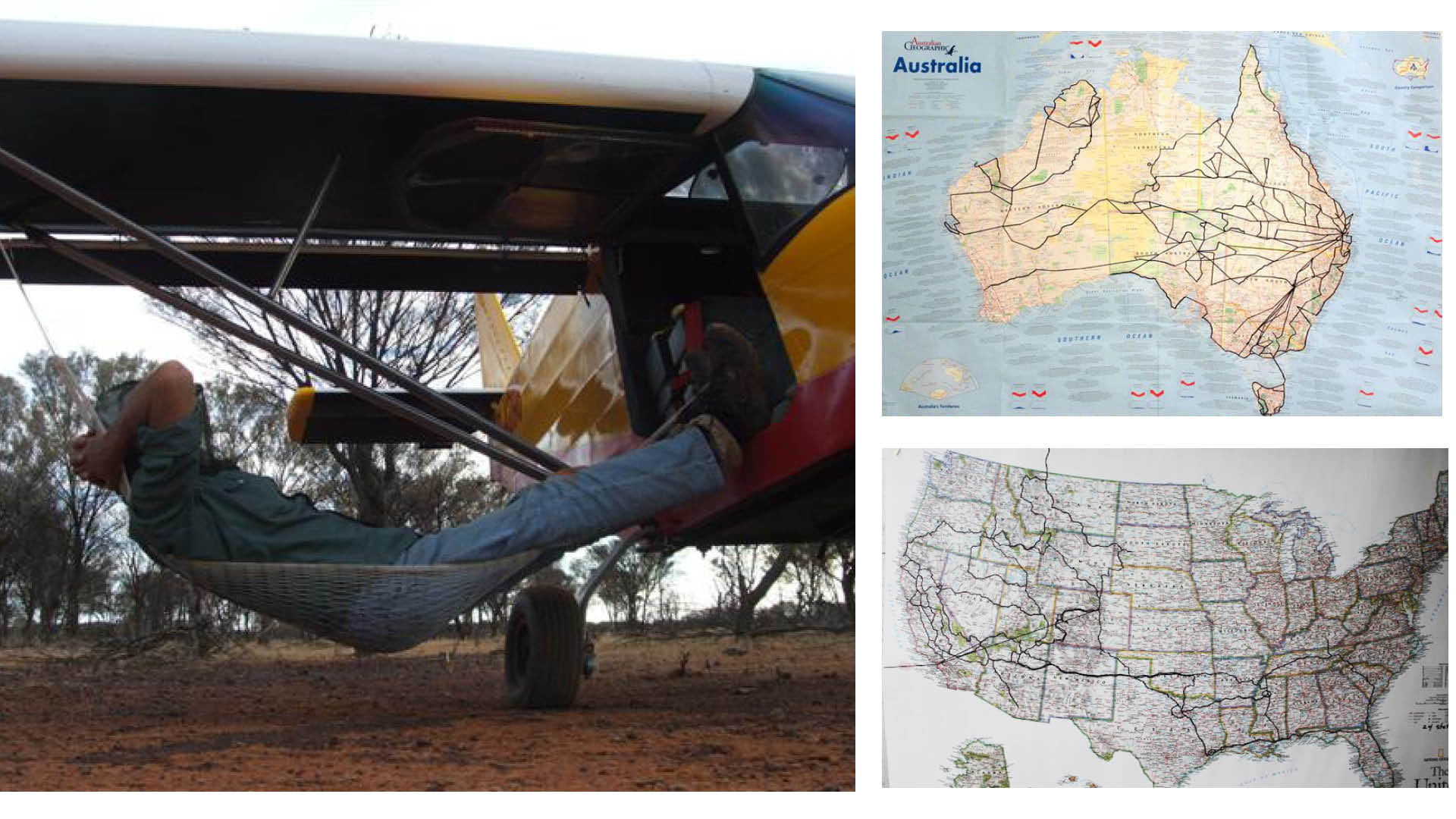 Advertising experts tell me that a photograph of the proprietor inspires trust and confidence, so I guess I’d better include one.. In inland Australia, the thermals get very rough by midday. It's much more comfortable in the shade of that high-lift wing.
I originally became interested in vortex generators while trying to improve STOL performance on my homebuilt aircraft. I tested three brands of production VGs and homemade ones and spent countless hours flight‑testing to find the best design. All vortex generators I tested worked well but their designs could be improved in user‑friendliness and appearance. Many were sharp, the extruded aluminium ones had a flat base that didn’t fit the wing’s contour. The sharp angular lines and square corners didn't suit a smooth aerofoil, they looked like stuck‑on afterthoughts.
As a practical designer and tinkerer, always looking to improve, I decided better vortex generators were needed. I designed my own with fully rounded and flowing lines, then flight‑tested them against production models and found the same performance with a better form. The best vortex forms when airflow progressively spills over an angled leading edge creating a slim, tight, tidy vortex that stays close to the wing surface, all the way to the trailing edge. The leading edge shape of the VG is critical to creating this vortex. Similarly, the base must be streamlined with no blunt edges that trip the boundary laye.
Stolspeed VGs feature a slim rounded fin for flexibility and a rounded, tapered base that flows into the wing surface. In clear polycarbonate, they’re nearly invisible and can also be painted to match the wing. They look like part of the wing rather than an afterthought.
I then looked for the best materials to make the VGs resilient and durable under harsh UV conditions. I chose polycarbonate because it’s tough, flexible, resilient, and can be injection‑moulded into any shape. This allows the base to follow wing curvature. Polycarbonate’s flexibility also allows the fin to ‘give’ and absorb impacts rather than damage the wing skin. Many polycarbonate grades exist from food‑grade to bulletproof. I selected the type used in Australia for skylights and roof panels under fierce sun.
Next I looked for the best adhesive. Other vortex generator suppliers recommend super glue. The aerodynamic forces on these VGs is very small, so such an aggressive adhesive is unnecessary and makes it nearly impossible to remove the VGs without damaging the wing paint. The adhesive I found is a solvent-free acrylic adhesive that holds very well but can be easily removed with no damage to the paint. It remains flexible, so can take a severe knock without breaking loose. It's also transparent, so when you place the VG, the colour of the underlying paint shows through vividly, making the base almost invisible. I laser cut to double side adhesive to exactly match the footprint of each VG to make the installation much easier.
I've really enjoyed testing and experimenting with vortex generators, and there's lots more yet to learn.
JG