
The True Story About Leading Edge Slats
How Zenair 701 & Savannah Aircraft Fly Better With VGs Than With Slats!
It was way back in 1990, at the Sun ’n Fun Fly-In in Lakeland, Florida, that I first heard about flying a Zenair CH701 without the leading edge slats. I was very interested in the CH701, so I was hanging around the Zenair display, where I met a couple of CH701 pilots from Colombia. (The usual reaction at this point is, “It must have been for the drug trade…” but that’s nonsense. This was the era of 532s and early 582s, and the drug syndicates didn’t need to fly over the jungle in two-stroke ultralights, they had the best Bell helicopters! The real reason there were so many CH701s flying there was that Colombian men are real macho and always ready for adventure, and a local manufacturer was building them ready to fly, so the aircraft suited them perfectly.
These fellows told me they had removed their slats and their aircraft flew better! That was a real surprise, since the leading edge slats are one of the main distinguishing features of the Zenair CH701. They spoke a bit of English, and I spoke a bit of Spanish, so I questioned them over and over again to be sure. They assured me the aircraft flew faster without slats, and landing speed was only slightly higher.
Ever since that encounter, I’d been telling Zenair CH701 and Storch pilots to try flying without slats but no one would. So I had to wait until I owned a similar aircraft myself to test it. Now, after thorough testing on my Savannah (a sibling of the CH701), the results are astounding. I’ll never put the slats back on. Two CH701 owners at our airfield have also removed their slats, with equally impressive results. We now have a surplus of used slats hanging in our hangars.
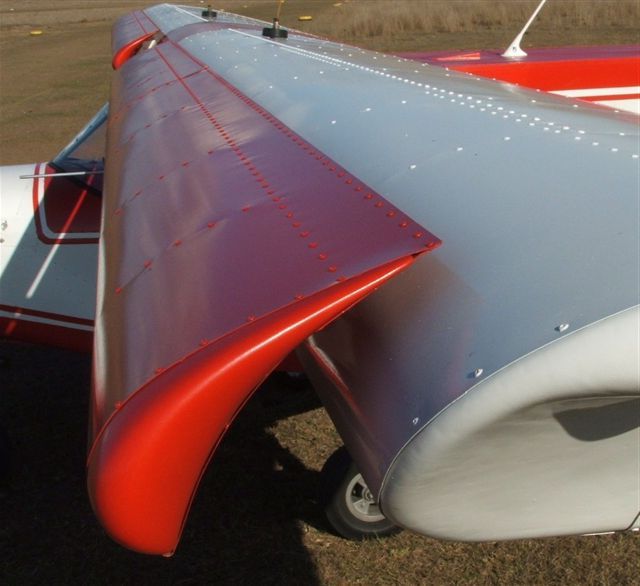
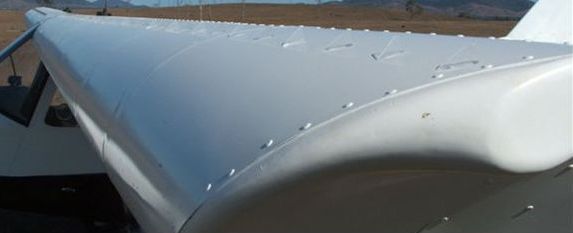
Leading Edge Flaps and VGs on a Savannah
Flight Testing Leading Edge Slats vs VGs
Leading Edge Slats on a Savannah Aircraft create lots of drag and disrupted airflow. VGs Instead of Slats on a Savannah Wing, the aircraft performed much cleaner, a truly excellent STOL wing. The vast reduction in drag allows all these aircraft to fly considerably faster for the same power, climb better, glide better, and, with the benefit of vortex generators, lift off and touch down just as short as with slats but with more control.
Performance Summary (Savannah): Fast cruise at 5200 rpm increased from 79 kt to 85 kt (+6 kt). Top speed rose from 94 kt to 103 kt (+9 kt). Fuel burn at 75 kt dropped from 17 L/hr to 13 L/hr (23.5% less). Best climb rate at 55 kt improved by 140 fpm, and best glide at 40–45 kt improved by 100 fpm.
Stall Speeds (idle power, no flap): With slats – no real stall, just a stable high-descent mush below 30 kt. Without slats, no VGs – distinct stall and roll to the left at 34 kt. Without slats and with VGs – no stall, just a stable mush below 30 kt. (VGs = Vortex Generators. L/hr × 0.26 = US gal/hr. Kts × 1.15 = mph.)
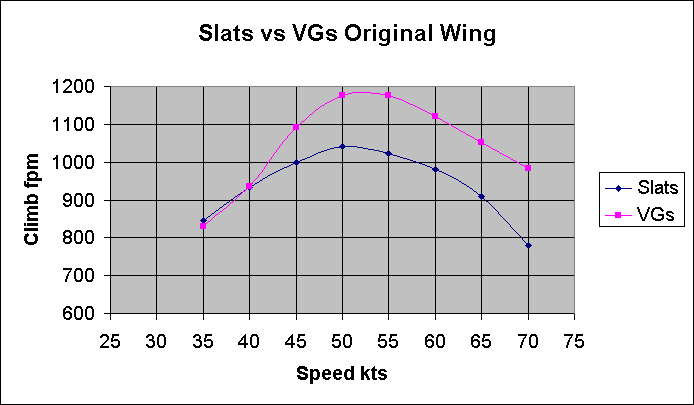
Testing was done on a Savannah kitplane from I.C.P. in Italy, a copy of the MXP 740 designed by Max Tedesco. It shares the same wing profile as the CH701 but has a longer fuselage and a different tail. Powered by a 100 hp 912ULS with a 4-blade Brolga prop pitched for climb (16° blocks), carrying the pilot (73 kg) and 30 liters of fuel.
All tests were done under similar conditions, within one hour of each other, same altitude, calm air, early morning before thermal activity. Climb and descent rates were timed between 2000–3000 ft QNH with a stopwatch. Straight-and-level and stall tests were conducted at 2000 ft QNH. Each with/without test was repeated three times. The airspeed indicator (ASI) accuracy was checked via GPS (4-way average). Corrections: 1 kt low at 70–80 kt, 1 kt high at 40–50 kt, and accurate at 60 kt. Indicated speeds below 30 kt are approximate but adequate for comparison. Full test results:
There was no trim change needed between configurations, confirming that slats provide no lift at cruise angle of attack, they only work above the normal stalling angle (~16°). Initial confusion about the center of gravity (C.G.) range in the manual (30–38.5%) was resolved when measuring from the actual leading edge rather than the slat. Corrected, the true range is 22–29%, consistent with typical wings.
The biggest surprise was 23% fuel savings. Measured on two 50-hour cross-country trips (Cape York and Tasmania). With slats: 17 L/hr. Without slats: 13 L/hr. Both at 75 kt average. That’s a total savings of $250 in fuel on one trip.
I expected some loss of STOL performance after removing the slats but with VGs, it actually improved. The aircraft now lifts off sooner, accelerates faster in ground effect, and climbs away more strongly. Landings are smoother and more forgiving, without the sudden sink associated with slats at high angles of attack.
Slats aren’t entirely useless, they’re helpful for power-on landings. You can drag the aircraft in below flying speed using power to control descent. But visibility is poor, and any power loss or wind shear at that point can be dangerous. Adding VGs while keeping the slats made no difference to stall performance, slats already handle that, but all the drag remained.
Flaperons now work far better without slats. They generate lift with little drag only a 50 fpm increase in descent rate from no flap to full flap at 40 kt. Full-flap landings are now smooth and controllable around 25 kt. This Savannah with VGs instead of slats flies remarkably well. It now outperforms any CH701 or Savannah with slats, both for STOL ops and cruise.
At NatFly 2006 (Australia’s version of Sun ’n Fun), I displayed my Savannah with VGs instead of slats and shared this story. Interest was huge, and now CH701 and Savannah owners across Australia are switching to VGs. Even the Savannah factory in Italy took notice, they purchased a set of VGs from me and have since released the Savannah VG model, with a redesigned leading edge and built-in vortex generators. Performance figures match closely with those of the original wing fitted with Stolspeed VGs.
The factory offers a VG leading-edge upgrade kit for around $1000. Personally, I’d wait, removing wings, drilling spar rivets, and realigning skins isn’t worth it unless there’s a clear performance gain. My original wing with Stolspeed VGs performs beautifully.
Residual slat brackets disrupt airflow and worsen stall behavior slightly. To remove them cleanly, use a thin cut-off disc on an angle grinder at 45°, cut shallow grooves on both sides, flex the bracket to snap it off, smooth any raised metal, replace visible rivets with countersunk ones, and fill the area with epoxy or polyester filler for a smooth finish.
I have a passion for STOL operations, and this Savannah with VGs is ideal. It performs so well I can’t resist showing off, even on long runways!
Fair skies and tailwinds,
JG